
What is the Pythagorean Theorem?
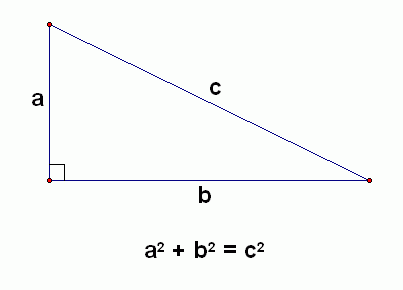
The Pythagorean Theorem states that, in a right triangle, the square of a (a²) plus the square of b (b²) is equal to the square of c (c²):
a2 + b2 = c2
Proof of the Pythagorean Theorem using Algebra
We can show that a2 + b2 = c2 using Algebra
Take a look at this diagram ... it has that "abc" triangle in it (four of them actually):
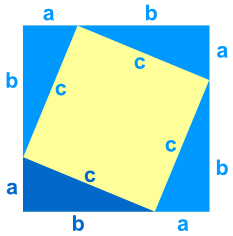
Area of Whole Square
It is a big square, with each side having a length of a+b, so the total area is:
A = (a+b)(a+b)
Area of The Pieces
Now let's add up the areas of all the smaller pieces:First, the smaller (tilted) square has an area of A = c²
And there are four triangles, each one has an area of A =½ab
So all four of them combined is A = 4(½ab) = 2ab
So, adding up the tilted square and the 4 triangles gives: A = c²+2ab
Both Areas Must Be Equal
The area of the large square is equal to the area of the tilted square and the 4 triangles. This can be written as:
(a+b)(a+b) = c²+2ab
NOW, let us rearrange this to see if we can get the pythagoras theorem:Start with: (a+b)(a+b) = c² + 2ab
Expand (a+b)(a+b): a² + 2ab + b² = c² + 2ab
Subtract "2ab" from both sides: a² + b² = c²
DONE!
Now we can see why the Pythagorean Theorem works ... and it is actually a proof of the Pythagorean Theorem.
This proof came from China over 2000 years ago!
There are many more proofs of the Pythagorean theorem, but this one works nicely.

This post is very informative and presents the topic in a clear, engaging way that’s easy to follow. I really appreciate the structured approach, which makes complex ideas much simpler to understand. For students struggling with tight deadlines, services that make my assignment online can be a real lifesaver, helping to manage workload efficiently. Overall, this is a valuable and practical piece of content that adds genuine insight. Looking forward to more helpful posts like this.
ReplyDelete